My photo
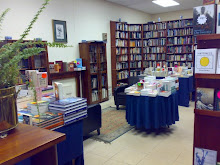
Shop 139, Irene Village Mall. Cnr. Nellmapius and Pierre Van Reyneveld Roads. Irene. Centurion.Gauteng. Republic of South Africa. Monday-Thursday : 09:00 - 19:00 Friday : 09 : 00 - 20 : 00 Saturday : 08 : 00 - 18 : 00 Sunday : 09 : 00 - 17 : 00 Telephone : 27 (0)12 662 2829 E-Mail : tallstories@megaweb.co.za There is no substitute for knowledge. Tall Stories is a book shop offering fine books for discerning readers. We sell only the best books: collectables, africana, publishers overstocks and quality pre-loved books. We also buy good books, every day of the week. Come to us for that elusive africana you have been searching for - be it botany, travel, hunting, zoology or other. Impress your friends with your collection of Dostoevsky and Murakami. We accept Visa, AMEX. and Mastercard

Tuesday, October 27, 2009

Tall Stories - Fine Books for Discerning People.Newsletter


I am pleased this year to be able to say that not only do I know of the Nobel Prize winner for Literature, but I have even read her. This in sharp contrast to my disgrace of last year, but the less said about that the better. Herta Müller, I can now say with some authority, is a worthy winner.

This being the world, earth, and inhabited by humans, bookmakers took bets on who would win the $1.42m prize. Most punters lost their money, although if any had put money on Müller they would have cleaned up at 50 to 1 odds.

The favourite for this year was Amos Oz, with Algerian novelist Assia Djebar running a close second.

According to Ladbrokes, Oz was odds-on favourite at 4 to 1. Phillip Roth was ranked at 7 to 1, with Haruki Murakami at 9 to 1, who would have been my choice. If he does not win it this year, he should do so soon, along with Tim Winton, who has sadly been overlooked twice for the Booker Award but will still get that if there is any justice in the world. Paul Auster was a rank outsider at 100 to 1 odds.

The Booker Man prize went to Hilary Mantel. This did not surprise the bookies at all as she was the odds-on favourite.

My partner suggested that we contrast the Nobel Awards with the slightly less exalted Ig Nobel Awards, announced in early October. This award states its ambition as being: "first make people laugh, then think". The winner in the category of literature this year was the Irish national police force for issuing 50 tickets to one "Prawo Jazdy", which in Polish means "driver's license." Of further interest was the Ig Nobel award for Mathematics given to Zimbabwean, Gideon Gono and the Zimbabwean Reserve Bank for printing bank notes in denominations from 1 cent, to $100 trillion, ($100,000,000,000,000), thus "...giving people an everyday way to cope with a wide range of numbers — from very small to very big".

This month we are featuring 2 unused books and one collectable book.

The Alexandria Link - by Steve Berry

A hidden treasure. A forgotten truth. Cotton Malone is in trouble. His son has been kidnapped and his bookshop in Copenhagen attacked, all because he is the only man alive who knows the whereabouts of the Alexandria link -- the means of locating the most important cache of ancient knowledge ever assembled: the legendary Library of Alexandria, which vanished without trace fifteen hundred years ago. Now, Malone is forced to join the search for a forgotten truth hidden within that vast literary treasure -- a truth that, if revealed, will have grave consequences, not only for Malone, but for the balance of world power ... 534 pages, December 2007 Published by Hodder & Stoughton

Published Price : R114.00.Tall Stories Price : R50.00

Delizia! The epic history of the Italians and their food by John Dickie

Buon appetito! Everyone loves Italian food. But how did the Italians come to eat so well?

The answer lies amid the vibrant beauty of Italy's historic cities. For a thousand years, they have been magnets for everything that makes for great eating: ingredients, talent, money, and power. Italian food is "city" food.

From the bustle of medieval Milan's marketplace to the banqueting halls of Renaissance Ferrara; from street stalls in the putrid alleyways of nineteenth-century Naples to the noisy trattorie of postwar Rome: in rich slices of urban life, historian and master storyteller John Dickie shows how taste, creativity, and civic pride blended with princely arrogance, political violence, and dark intrigue to create the world's favorite cuisine. "Delizia!" is much more than a history of Italian food. It is a history of Italy told through the flavors and character of its cities.

A dynamic chronicle that is full of surprises, "Delizia!" draws back the curtain on much that was unknown about Italian food and exposes the long-held canards. It interprets the ancient Arabic map that tells of pasta's true origins, and shows that Marco Polo did not introduce spaghetti to the Italians, as is often thought, but did have a big influence on making pasta a part of the American diet. It seeks out the medieval recipes that reveal Italy's long love affair with exotic spices, and introduces the great Renaissance cookery writer who plotted to murder the Pope even as he detailed the aphrodisiac qualities of his ingredients. It moves from the opulent theater of a Renaissance wedding banquet, with its gargantuan ten-course menu comprising hundreds of separate dishes, to the thin soups and bland polentas that would eventually force millions to emigrate to the New World. It shows how early pizzas were disgusting and why Mussolini championed risotto. Most important, it explains the origins and growth of the world's greatest urban food culture.

With its delectable mix of vivid storytelling, groundbreaking research, and shrewd analysis, "Delizia!" is as appetizing as the dishes it describes. This passionate account of Italy's civilization of the table will satisfy foodies, history buffs, Italophiles, travelers, students -- and anyone who loves a well-told tale.

Published Price : R144.00. Tall Stories Price : R75.00

Our COLLECTABLE book for this month is.....British Fresh-Water Fishes (Two Volumes ) by Rev. W. Houghton.

First Edition xxvi, 202pp. William Mackenzie : London (1879). First Edition. Very Good / No Dust-Jackets. Folio. Illustrated with 41 full page, tissue-guarded colour plates as well as vignette head pieces, brick-red cloth, with gilt piscatorial emblems. All edges gilt. The 41 colour-printed xylograph plates are by Benjamin Fawcett of Driffield after A.F.Lydon, and another 64 woodcuts also by Lydon. Tear in the cloth of volume 1 (30 mm). Cloth on the spine-ends frayed. Loss of cloth on all corners. No inscriptions, all plates present and bright. Hinge giving (page 20), volume 1. Front paste-downs of both volumes - tears in the gutter. Overall a lovely set, with exceptional plates.

Alexander Francis Lydon (1836 - 1917) was an English engraver of natural history. He worked for Benjamin Fawcett the printer, to whom he had been apprenticed from an early age. Benjamin Fawcett (December 1808 - January 1893) was one of the finest of English nineteenth century wood block colour printers. He pioneered a system of engraving from multiple wood blocks that resulted in vivid, finely coloured works such as this marvelous book. This process was called chromoxylography (colour wood engraving). Rev. W. Houghton, served as rector of Preston-on-the-Weald Moors, Shropshire. At the same time, he was a serious naturalist who had previously authored Sea-side Walks of a Naturalist, and was a Fellow of the Linnaean Society of London, a scientific society for the study of biology founded in 1788. For this work, Houghton studied the specimens in the collection of the British Museum.

Price : R9000.00

Tall Stories can be found on the world wide web, thusly :

E-mail : tallstories@megaweb.co.za

website:
http://www.tallstoriesbookshop.com/

Facebook: Log in to Facebook, use the search facilities, type in "Tall Stories - Fine Books for Discerning People". You should land up with 2 search results, one for a group page and another for the retail page. We recommend that you join the retail page
Twitter: http://www.twitter.com/TallStoriesBook
We are also a member of that illustrious and august body otherwise known as The Southern African Book Dealers Association and you can search our books on that site as well.

UNSUBSCRIBE from this newsletter.

In real space, we are here :

Shop 12, Irene Village Mall, Cnr. Nellmapius & Pierre Van Reyneveld Roads
Irene
Centurion
Gauteng
Republic of South Africa


Telephone :27 + (0) 12 662 2829

Hours:
Monday - Thursday : 09 : 00 - 19 :00
Friday : 09 : 00 - 20 : 00
Saturday : 08 : 00 - 18 : 00
Sunday : 09 : 00 - 17 : 00

Thursday, October 22, 2009

Old Pleasures Rediscovered.


The Ghost, by Robert Harris

In interviews given to the press Robert Harris has had to answer many questions about his new book. To all that have read it, it seems closely modeled on Tony and Cherie Blair and their political reign in the UK. Harris has stated that he started out as an enthusiastic supporter of New Labour in the UK, but grew increasingly disillusioned as, like the rest of the world, all stood aghast at the direction the country took and the fashion in which it made itself into the lapdog of the USA. To many it seemed betrayal of earlier promise, and quite inexplicable. In this book Harris has crafted an explanation, and it will intrigue you. It is a wonderfully well-written political thriller, with more than a dash of conspiracy theory, and a marvelous twist, just after you think you’ve unraveled the plot all by yourself and are feeling smug, that will make you reconsider all you know of the history, even if for only a moment.

The book’s protagonist is a ghostwriter, one who immerses himself in the lives of other, well-known people, in order to write their autobiographies. In doing this he blurs the lines between his memories and theirs, and makes order and sense of their lives in such a way that lives that could have seemed dull become interesting and meaningful. As a chameleon of sorts, he slips easily into the skins of his subjects and, in a sense, becomes them for the time it takes to write the book.

His services are called upon to complete the memoirs of the past British Prime Minister, after the original ghostwriter is found drowned in Martha’s Vineyard. In the process he unravels a plot so dastardly that it would have made Machiavelli skip with glee. Though not beyond the call of far-fetched, you find yourself nodding thoughtfully and thinking – ‘could be, could be’. The character of Cherie/Ruth comes in for more than a bit of stick, as does British and American politics and the wars in the Middle East.

Before becoming a full-time writer Robert Harris worked for the BBC and was the political editor of The Observer. He is the author of several works of non-fiction, including A Higher Form of Killing: Secret Story of Gas and Germ Warfare and Selling Hitler: Story of the Hitler Diaries, but it is as a novelist that he really shines. His first novel, Fatherland, an alternative history in which the Germans emerged victorious from the Second World War, was a best seller and successfully filmed, as was his second, Enigma, about the breaking of the Enigma code at Bletchley Park in the Forties. The huge success of these two made it possible for him to be able to devote himself to full-time writing.

He is married to the writer Gill Hornby, who is the sister of best-selling author Nick Hornby.

There’s a lot of fine writing in that family.

Saturday, October 17, 2009

Lives Less Ordinary


Adolf Galland


Though war, death and destruction are almost always bad things in the grand scheme of things, some of those involved or caught up in it, by virtue of our prurient interest in these matters, come to our attention. Some of these people lead, or have lead, remarkable lives. Which is not to say that others do not, nor that one would have to have a hand in the slaughter of ones fellows to have such a life. Now, before succumbing utterly to the doctrine of the death of a thousand qualifications, I come to the point.

We bought a copy of The First and the Last, the autobiography of Adolf Galland. A man who lived a remarkable life. He was trained as a fighter pilot in the German Luftwaffe prior to the Second World War. He flew missions with the Condor Legion in the Spanish Civil War and the Luftwaffe in WW11. In 1941 he was placed in command of Germany's fighter squadrons and in the next year became the youngest general in the German military, aged 29. He remained in the same command until 1945 when, after pointing out that Hermann Goering was an idiot, something that, while patently true, did not endear him to either Adolf Hitler, or the commander of the Luftwaffe, Hermann Goering, and caused him to be dismissed from the High Command. He was sent back to active service and commanded the first ever jet fighter squadron. He survived the war with 105 victories to his credit, if credit be the right word.


In civilian life he built and ran a successful aviation firm. He became fast friends with some of his former adversaries, including the British fighter aces Johnny Johnson and Douglas Bader. He also survived three marriages, and died in 1996, at the ripe old age of 83.

Monday, October 12, 2009

Child 44, by Tom Rob Smith


Quite when the old-style Agatha Christie crime novel died I am not sure, but die it did. To be fair one should actually say that it evolved, or morphed, or progressed, or just changed into something else. The formulaic nature of the old-style very British crime novel, one supposes, could not remain unchanged in a world that has shrunk dramatically, where cultures are closer than ever and the most esoteric information a mere mouse click away. There have been significant changes wrought to the genre by French, Spanish, German and American authors, not to mention the Scandinavians. Why this is, is something to ponder of a dark and stormy night. (How Iceland, for example, can be a hotbed of crime, where they record a murder every five years or so, is something we need not dwell on here.)

For me one of the most interesting things about crime fiction is that it has in some senses evolved into something more than it used to be. Some authors have blurred the lines between crime fiction and literature, like Perez-Reverte and Daniel Pennac, making it so much more than just a detective with a personality flaw, and less than perfect home life, investigating a murder.

I am also partial to exotic settings, I have to admit. I well remember how much I enjoyed reading Martin Cruz Smiths’ Gorky Park, in a time when stories set in the U.S.S.R. were the sole preserve of the spy novel.

In this spirit is Child 44. The story follows the investigation into a series of murders of children in the Soviet Union of the early Fifties, an era of burgeoning interest. It was the last years of Stalin-inspired fear and paranoia, where no one was above suspicion, and the start of the slightly enlightened era of Kruschev. Leo Demidov is a militia officer who becomes obsessed with apprehending the killer, even though every obstacle is placed in his way, chief of these being that in the worker’s paradise that is the Soviet Union, there is officially no crime and therefore nothing to investigate. Indeed, by investigating the murders, he puts himself and his family at risk. He is also victim to internal politics and the ambition of a particularly brutal colleague which causes him to lose his rank and be exiled to a remote Militia outpost in Siberia as a private militiaman. After the death of Stalin, when society opens and becomes slightly less repressive and more open, he continues his surreptitious investigation until he finds the killer.
In many respects it is a common-or-garden crime thriller with not unpredictable twists and resolutions, but the setting makes it better than the usual offering. The writing is good and the atmosphere of suspicion and repression is quite remarkable. Perhaps most impressive is the development of the protagonist, from arrogant Militia officer to haunted, hunted investigator – nicely judged and well executed indeed.

This novel was long-listed for both the Man Booker Prize and the Costa First Novel Award in 2008.

Wednesday, September 30, 2009

Blood and Chess


Zugzwang, by Ronan Bennett.

Zugzwang, n.: an obscure move in an even more obscure game commonly thought to have originated in Persia, whereby ritual war is conducted between two parties, sometimes resulting in the loss of bodily fluids, mainly sweat and tears instead of the more usual blood.

This is a novel that has all the elements one would wish for in an intelligent thriller: chess, murder, psychology and revolutionary politics, all set against the backdrop of St. Petersburg, in the year 1914 A.C.E. 

This last mentioned may be the best part of the book. Bennett seems to have done his research and his evocation of the time and the place is convincing and, in parts, quite beautiful.  So too the atmosphere of the times, the closed-in feeling of history holding its breath, the impending world- altering historical events, all combined with the expectations of the chess tournament taking place in the city, for the crowning of the first Grand Master of chess.
Chess may not be your cup of tea, and the diagrams of the unfolding game between the main protagonist, Dr. Otto Spethman and his violin virtuoso friend, Reuven Moiseyevich Kopelzon, difficult to follow, but the intricacies of the game, the hidden moves and the planning and diabolical cunning involved serve as perfect metaphor for the revolutionary intrigue of the time and place.
Add to this some Freudian sexual repression, a murder or three, a dash of poetry, some snow and vodka and a couple of quite surprisingly steamy sex scenes (Ronan, you old devil you, who knew?) and you have a quite intriguing book.
 
Ronan Bennett has written several screenplays, the most recent of which is Public Enemies, starring Johnny Depp.

And for those of you who imagine novelists to be weedy, uninteresting types, Bennett was incarcerated twice. Once at age 18 when he was accused of taking part in an IRA bank robbery during which a policeman was shot and killed. He was convicted and sent to Long Kesh prison, but released less than a year later due to the flimsiness of the case against him. In 1978 he was held in remand for 16 months, accused of plotting to plant bombs in the UK. He conducted his own defence and was acquitted.

He also holds a Ph.D. in history from King’s College London.

Best quote by Bennett: "Writers should be distrustful of authority," he says. "I think writers should always be in a position of tension in relation to governments and power and authority." NPR

Friday, September 11, 2009

Tall Stories makes a point.


We are attending the annual Knifemakers Guild of Southern Africa where we are selling books with a fine edge. As we are honed well, things are going swimmingly.

The show takes place over two days every year. This is day two, and we are raring to go, though tired in manner of canines.

Saturday, June 27, 2009


Now that our discontent is starting to wane, after the longest night and shortest day have come and gone, signifying our gradual emergence from the doom and gloom of winter into warmth and light, we present our second ever newsletter to you, the fortunate few.

Though the fingers are still thawing on the keyboard we look forward to happy hours of reading under the duvet. Did you know that there are strange English-type fellows and birds who call this object a counterpane? I know, astonishingly strange these Anglo johnnies are with their odd language.

We were almost overcome with excitement this last month when we obtained a couple of copies of Tim Winton's latest novel, Breath. For those of you who have not made the acquaintance of this marvellous antipodean author – shame on you. Straight to bed and no dinner for you tonight. The man is a genius and you must rush out forthwith and obtain copies of everything he has written and devour it soonest. You will not be sorry. Well, you may be – after all there's no accounting for taste.

I find that I am rationing myself in the reading of his books. It happens with authors I really like. I fear that there is a finite number of books that they will write and therefore I try to prolong the pleasure in my reading by always having a title in reserve. Not very lucid or clever, I know, as there are so many authors out there that are worthwhile that the list will not end but will expand ever outwards like the universe (according to some scientists).

Tim Winton's writing reminds one of the style of J.M. Coetzee, whose stripped down, spare and lean prose strikes with the concentration of singularity. His writing is earthy and so vitally alive that it feels like your own heartbeat.

Enjoy.

This month we are featuring 2 unused books and one collectable book.

On the Edge - My Story by Richard Hammond.

From the first ridiculous stunts on his tricycle to his increasing and near obsessive attraction to speed and the smell of gas, this is the high-octane life of TV personality Richard Hammond. A lively and intelligent communicator, TV soon beckoned for Hammond. He became one of the daredevil trio--along with Jeremy Clarkson and James May--who have made an enormous, world-wide success of the revamped BBC TV program Top Gear, Hammond describes the personalities, the camaraderie, and the stunts with which the trio entertains their weekly audiences, including the day of his 300 MPH crash that took his show off the air, put him into a coma, and plunged a nation into mourning. The stages of recovery as his shattered mind reformed are covered, as are the milestones in his slow recovery to full health and his return to Top Gear.

309 pages, October 2007 Published by Weidenfeld & Nicolson
Published Price : R245.00
Tall Stories Price : R99.00


Beneath The Bleeding by Val McDermid
Tony Hill, criminal profiler and hero of the television series Wire in the Blood, is back in a terrifying psychological thriller from bestselling author Val McDermid. Troubled criminal profiler Dr Tony Hill may have problems of his own but when Bradfield CID need him, he's the best they've got. While the police sometimes view him with the same suspicion as some of their suspects, DCI Carol Jordan is one of the few who appreciates his unique talents. For Tony, the feeling is more than mutual. Both have survived horrifying ordeals of their own. In Beneath the Bleeding they must risk them again. As the two return to duty, it's Val McDermid at her terrifying best.

404 pages, September 2007 Published by HarperCollins Publishers

Published Price : R195.00
Tall Stories Price : R85.00

Our COLLECTABLE book for this month is a rare edition of ...... Tom Stoppards's Rosencrantz and Guildenstern are Dead.


First Edition.Faber & Faber : London (1967) Very Good +/ Very Good. Blue Cloth. Octavo. 96 pp. Gilt titles on the spine. Slight spinal lean. Edges of the boards slightly dusty. Ink name of a previous owner on the front free end paper. Very, very light tanning to the end-papers. Spine of the dust-jacket browned. Very minor line of tanning to the interior top edge of the dust-jacket (2mm). Very light wear to the top and bottom edge of the spine of the dust jacket (1 mm chip, couple of millimetre closed tears). Slight soiling on the rear panel of the dust-jacket (more shelf-wear than soiling).


Sir Tom Stoppard OM, CBE, FRSL (born 3 July 1937) is a British playwright. He has written plays such as "The Coast of Utopia", "Arcadia", "Rosencrantz & Guildenstern Are Dead", and "Rock 'n' Roll". He co-wrote the screenplays for "Brazil", "Shakespeare in Love", "Empire of the Sun" and "The Russia House" and is rumoured to have assisted George Lucas with some of the dialogue for "Indiana Jones and the Last Crusade". It is also rumoured that Stoppard worked on "Star Wars Episode III: Revenge of the Sith", though he never received any official or formal credit in this role. He worked in a similar capacity with Tim Burton on his film "Sleepy Hollow". He was born Tomás Straussler in Zlín, Czechoslovakia. He fled to Singapore with other Jews on 15 March 1939, the day that the Nazis invaded Czechoslovakia. In 1941, the family was evacuated to Darjeeling, India, to escape the Japanese invasion of Singapore. His father, Eugen Straussler, remained behind as a British army volunteer, and died in a Japanese prison camp after capture. Stoppard completed his first play ("A Walk on the Water", later retitled "Enter a Free Man") in 1960. This first play was optioned and staged in Hamburg. Stoppard conitnued to work in London for "Scene" magazine often writing under the pseudonym of William Boot which he took from Evelyn Waugh's "Scoop". On the 11th of April, 1967, "Rosencrantz and Guildenstern are Dead" opened to acclaim at the Edinburgh Festival and Stoppard became an international success. Indeed he has become an adjective : "Stoppardian" has become a term used to refer to works in which an author makes use of witty statements to create comedy while addressing philosophical concepts. The linguistic complexity of his works, with their puns, jokes, innuendo, and other wordplay, is a chief characteristic of his work. In 2008, Stoppard was voted number 76 on the Time magazine's list of the most influential people in the world. "Rosencrantz & Guildenstern Are Dead" is one of Stoppard's most famous works. It is a comedic play which casts two minor characters from Hamlet as its leads, but with the same lack of power to affect their world or exterior circumstances as they have in Shakespeare's original. Hamlet's role is similarly reversed in terms of his stage time and lines, but it is in his wake that the heroes drift helplessly toward their inevitable demise. Rather than shaping events, they pass the time playing witty word games and pondering their predicament. It is similar to Samuel Beckett's absurdist "Waiting for Godot", particularly in the main characters' lack of purpose and incomprehension of their situation. In 1990, "Rosencrantz and Guildenstern are Dead", was made into a film staring Gary Oldman as Rosencrantz and Tim Roth as Guildenstern. The film was directed by Stoppard and won the Golden Lion Award. - Sourced (text & images) from Wikpedia.
Price: R11 400.00

Tall Stories can be found on the world wide web, thusly :

E-mail :
tallstories@megaweb.co.za

website:
http://www.tallstoriesbookshop.com/

Facebook: Log in to Facebook, use the search facilities, type in "Tall Stories - Fine Books for Discerning People". You should land up with 2 search results, one for a group page and another for the retail page. We recommend that you join the retail page
Twitter: http://www.twitter.com/TallStoriesBook
We are also a member of that illustrious and august body otherwise known as The Southern African Book Dealers Association and you can search our books on that site as well.


UNSUBSCRIBE from this newsletter.

In real space, we are here :

Shop 12, Irene Village Mall, Cnr. Nellmapius & Pierre Van Reyneveld Roads
Irene
Centurion
Gauteng
Republic of South Africa


Telephone :27 + (0) 12 662 2829

Hours:

Monday - Thursday : 09 : 00 - 19 :00
Friday : 09 : 00 - 20 : 00
Saturday : 08 : 00 - 18 : 00
Sunday : 09 : 00 - 17 : 00